Rotating around and wiggling her arm just a little bit further, Brie seemed optimistic. Afterall, we had arrived on St. Lazaria less than 5 hours ago and were already grubbing.

Grubbing is the affectionate term for blindly, but slowly and gently, reaching your hand, and often entire arm, into a seabird burrow. After another slight reposition, she carefully extracted her hand from the burrow and in it was a tiny fluff ball of a bird. “Fork-tailed chick”, she explained, “and one of the adults is in there!” Still smiling, she slid the chick back into the burrow. The two of us hatched a plan to hike back to camp, eat a quick dinner, grab the geolocators, and get back here.


St. Lazaria
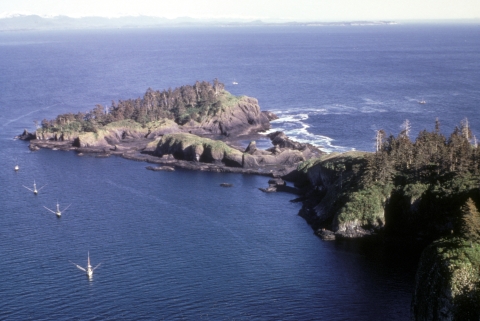
At the edge of Sitka Sound, St. Lazaria Island is a rugged volcanic island and part of Alaska Maritime National Wildlife Refuge. Despite its relatively small size (less than one mile long!), it provides vital nesting habitat for seabirds. During the summer, over half-million breeding seabirds call the 65-acre island home.
Tufted puffins nest in burrows along cliffsides. Black oystercatchers run across the volcanic rocks. Common murres perch precariously on cliff edges. Glaucous-winged gulls dive bomb from ahead.
And the ones we were here to monitor —storm-petrels — tunnel into the forest, shrub, and grassland floors. There are about 20 species of storm-petrels globally, two of which nest on St. Lazaria: fork-tailed and Leach’s storm-petrels.
Not just the birds
Aside from the avian species we hoped to find, we were also keeping our eyes out for several species we hoped not to find—invasive species. Invasive species pose significant environmental, ecological, and economic threats. Due to remote isolated habitats, islands are particularly vulnerable to the devastating impacts of invasive species invasive species
An invasive species is any plant or animal that has spread or been introduced into a new area where they are, or could, cause harm to the environment, economy, or human, animal, or plant health. Their unwelcome presence can destroy ecosystems and cost millions of dollars.
Learn more about invasive species . Native island species are often specialists, occupying specific ecological roles, and can be readily outcompeted by introduced, generalist invasive species. Additionally, many island species evolved without predators, so they may be defenseless to introduced invasive predators.

Back to the field
Two hours later, we were hiking back up The Nose with field gear in tow. “The Nose” is the narrow ridge that leads from the volcanic tide pools up into the higher elevation forested side of St. Lazaria. And somewhere we’d hike multiple times each day over the next 10 days.
Back at the burrow, I was thankful that we flagged it. The entire ground floor is littered with burrows-- old, new, and reused. Brie donned her grubbing gear while I prepped the geolocator toolbox.
Because burrows are narrow – storm-petrels don’t dig these with our arms in mind – you want your arms to be as small as possible. That means no extra layers outside of a long-sleeved t-shirt. Consequently, grubbing gear consists of a cutoff raincoat (no sleeves), tight neoprene sleeves (think shoulder-length arm warmers), and nitrile gloves with fingertips cut off (better dexterity). Not sure it’ll be on the runway anytime soon, but it’s definitely the glamour look of a seabird biologist!
Why We Were Grubbing
The Alaska Maritime National Wildlife Refuge has been monitoring storm-petrels and other seabirds at St. Lazaria since the 1990s. But all that work only tells us about a part of their lives. Like most seabirds, storm-petrels only return to land during the breeding season - in Alaska about five months from May through September. They spend their winters at sea, making them very difficult to study. As a result, researchers know very little about basic storm-petrel biology during the winter months – we didn't even know for certain where they go. Until now.
Using tiny electronic devices called geolocators, we can track where storm-petrels go when they leave the breeding colony each fall until they return the next spring. These geolocators, about the size of a small sunflower seed, are attached to a bird’s leg and record light levels throughout the winter. From that light data, scientists can calculate a location each day. Because conditions during the winter months can have a major impact on the survival and future breeding success of seabirds, identifying where storm-petrels are spending the winter is a vital piece to their conservation. Stay tuned for a follow-up story after geolocators are retrieved and analyzed.

What We Didn’t Find
The other mission in our two missions, one island project was early detection surveys for invasive species. We were looking for invasive plants, mammals, and green crabs.

The primary concern for terrestrial plants is from seeds that accidentally hitchhiked onto the island via boots, tents, or other gear. While traversing the island for the seabird related fieldwork, we kept an eye out for invasive plant suspects, such as orange hawkweed, oxeye daisy, and white sweetclover.
Across Alaska, there has been significant efforts to identify invasive plant species likely to cause large impacts to native ecosystems. Carlson et al. developed an invasiveness ranking system that organizes plants on a scale from 0-100, with larger numbers presenting higher invasive probability/impacts. This allows invasive species practitioners across the state to prioritize efforts on species that are “highly” or “extremely” invasive. Thankfully, we didn’t find any invasive plants!
In addition to terrestrial plants, we kept our eyes out for mammal signs (tracks and scat). Invasive mammals, such as rodents, can be extremely devastating to island ecosystems. Invasive rats decimate native bird species by eating eggs, chicks, and adults, and destroying nesting habitat. There’s also evidence of indirect impacts to intertidal communities. Again, thankfully, we didn’t find any sign!
Lastly, we conducted molt walk surveys for early detection of invasive green crabs. This is fun survey that anyone can do along coastlines in Alaska! It involves searching wracklines, an accumulation of debris along the shore, for a designated amount of time, collecting crab carapaces or molted shells, and recording what you find. Because of the tidal influence and lack of wracklines, we adapted the survey to tidepools as they served similar purposes of collecting carapaces and were flushed each tide cycle on St. Lazaria.
Invasive green crabs are bad news (listed in the top 20 on the Invasive Species Specialist Group’s list of World’s Worst Invasive Alien Species!). Unfortunately, they have been found in southern Southeast Alaska, so we need to be prepared for potential detection elsewhere. Fortunately, dedicated state, federal, and tribal agencies, along with individual Alaskans, have been conducting early detection surveys and rapid response planning for the crabs. Invasive green crabs have the potential to wreak havoc on the coastal resources that fish, wildlife, and Alaskans depend on. They are aggressive hunters, outcompeting and consuming native crab species, such as juvenile Dungeness, and dig up important eelgrass habitats, vital for juvenile fish and migrating waterbirds.
Thankfully, we didn’t find any evidence of invasive green crabs either!


10 Things I Learned in 10 Days on St. Lazaria (as a non-seabird biologist)
- Seabird colonies are NOISY.
- Banana slugs, while native and important to the ecosystem, are one of my least favorite things to touch, especially when surprised by the cool, slimy texture while gentle reaching into a burrow.
- Hiking on volcanic rocks destroys the rubber soles of boots very, very quick.
- Tides are everything. You don’t want to get stuck on the wrong side of the channel during a hightide, especially at night.
- Storm-petrels defense mechanism is to regurgitate orange-pink oil and anything they ate.
- That oil smells fishy, sweet, and vinegary… and never comes out of clothes.
- There is no experience that compares to standing in the dark as storm-petrel colonies return and depart from burrows for feeding. Thousands upon thousands of birds flittering through the sky like moths to a light, narrowly missing each other and you every second.
- Camping on an island with a storm-petrel colony means it’s just as loud at night as it is during the day.
- Tunneling through thick salmonberry stands is a feat of both physical and mental strength.
- Invasive species have the potential to impact so many different facets of ecosystems and what we each individually care deeply about. (Ok- this one I knew but further strengthened my appreciation for the importance of invasive species prevention).

The Power of Collaboration
While at first glance it might not be obvious what seabirds and invasive species have in common, by taking a step back, the larger mission comes into focus. St. Lazaria, like other islands, is a vulnerable ecosystem, and it’s a place on which storm petrels, and many other species, rely. One unwelcome, invasive species could disrupt the magic that occurs on St. Lazaria Island. Through shared resources and working together, we can achieve the goals of Alaska Region USFWS more efficiently and, hopefully, preserve the magic.